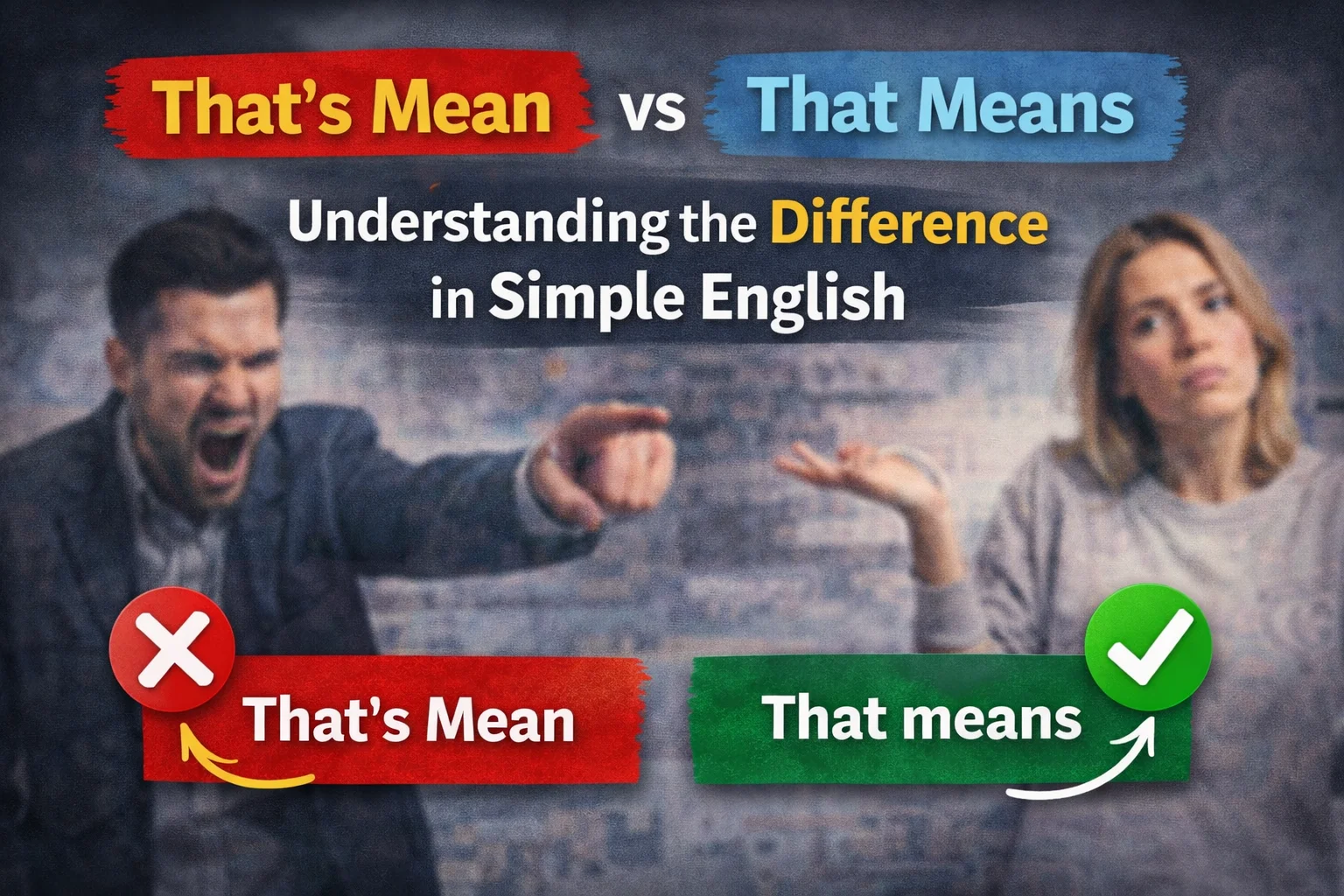
English can sometimes feel confusing. Two phrases may look almost the same but mean different things. One good example is That’s Mean vs That Means. Many people mix them up while speaking or writing.
Both phrases use the word “mean,” but they work in different ways. One phrase talks about someone being unkind. The other explains the meaning of something. Because they sound similar, learners often use the wrong one.
The good news is that the difference is easy to learn. Once you understand how each phrase works, you will rarely confuse them again. In this guide, we will explore That’s Mean vs That Means in a simple and clear way.
We will look at meanings, grammar rules, examples, and useful tricks. By the end of this guide, you will understand when to use each phrase correctly in everyday English.
Why People Confuse “That’s Mean” and “That Means”
Many English learners struggle with That’s Mean vs That Means because the phrases look almost identical. Only one small letter changes the meaning. Yet that tiny change can completely change the message.
The phrase “that’s mean” usually talks about someone being rude or unkind. For example, if someone laughs at another person’s mistake, a friend might say, “That’s mean.” Here, the speaker is describing behavior that hurts someone’s feelings.
In contrast, “that means” explains the meaning or result of something. It connects one idea to another. For example: “The lights are off. That means nobody is home.”
Because both phrases include the word “mean,” people often assume they work the same way. However, their grammar roles are different. One describes behavior, while the other explains meaning or consequences.
Understanding this simple difference makes it much easier to use the phrases correctly in daily communication.
Quick Comparison of “That’s Mean” vs “That Means”
Before going deeper, it helps to see the difference clearly in a simple table. This quick comparison highlights how the phrases work in everyday English.
| Phrase | Meaning | Grammar Role | Example Sentence |
|---|---|---|---|
| That’s mean | Something is unkind or rude | Adjective phrase | “Making fun of him is mean.” |
| That means | Explains the result or meaning | Verb phrase | “The store is closed. That means we must return later.” |
| That’s mean | Talks about behavior | Emotional description | “Ignoring her message is mean.” |
| That means | Explains information | Logical explanation | “The alarm rang. That means there is danger.” |
This table shows the key idea in That’s Mean vs That Means. One phrase describes feelings or behavior. The other explains meaning or results.
Seeing the difference side by side helps learners remember it more easily.
What Does “That’s Mean” Mean?
The phrase “that’s mean” is used when someone behaves in an unkind or hurtful way. It expresses disapproval of a person’s actions.
In simple terms, “that’s mean” means something is rude, unfair, or not nice. People often say it when they see someone treating another person badly.
For example, imagine a child hiding another child’s lunch as a joke. A teacher might say, “That’s mean. Give it back.” The phrase helps show that the action is not acceptable.
Here are some more examples:
- “You broke her toy on purpose. That’s mean.”
- “Calling someone names is mean.”
- “Laughing at his mistake is mean.”
When learning That’s Mean vs That Means, remember that “that’s mean” focuses on emotions and kindness. It describes behavior rather than explaining meaning.
Parents, teachers, and friends often use this phrase when teaching people how to treat others with respect.
What Does “That Means” Mean?
The phrase “that means” explains the meaning or result of something. It connects one idea with a conclusion or explanation.
For example:
- “The clouds are dark. That means it might rain.”
- “The store sign says closed. That means we must come back later.”
- “You passed the test. That means your hard work paid off.”
In each example, the phrase helps clarify what a situation indicates.
When studying That’s Mean vs That Means, remember this simple rule: “that means” explains information.
Teachers use this phrase frequently in classrooms. It helps students understand cause and effect. For instance, a teacher might say, “Water freezes at zero degrees. That means ice forms at that temperature.”
Because it explains meaning and results, this phrase appears often in conversations, lessons, and instructions.
Grammar Breakdown: Why These Phrases Work Differently
Understanding grammar helps clarify That’s Mean vs That Means.
The phrase “that’s mean” is actually a contraction. It combines the words “that is” and “mean.”
So the full sentence becomes:
“That is mean.”
In this sentence, “mean” works as an adjective describing behavior.
Example:
“That joke is mean.”
Now consider “that means.”
In this phrase, “means” is a verb. It describes the action of explaining or indicating something.
Example:
“That symbol means danger.”
Here is a simple grammar comparison.
| Phrase | Full Form | Word Type | Function |
|---|---|---|---|
| That’s mean | That is mean | Adjective | Describes behavior |
| That means | That means | Verb | Explains meaning |
| That’s mean | That is mean | Description | Talks about kindness |
| That means | That means | Explanation | Shows result |
This grammar difference explains why That’s Mean vs That Means cannot be used interchangeably.
Real-Life Examples of “That’s Mean”
Examples help make grammar rules easier to understand. Let’s look at everyday situations where “that’s mean” is the correct phrase.
Imagine a student laughing at another student who answered a question incorrectly. A teacher might respond, “That’s mean. Everyone is learning.”
Another example could involve siblings. If one sibling hides another’s favorite toy just to upset them, a parent might say, “That’s mean. You should return it.”
Here are some additional examples:
- “You shared her secret without permission. That’s mean.”
- “Making fun of someone’s accent is mean.”
- “Taking credit for his work is mean.”
When comparing That’s Mean vs That Means, these examples show that “that’s mean” focuses on people’s actions and feelings.
It helps point out behavior that may hurt someone emotionally.
Real-Life Examples of “That Means”
Now let’s look at situations where “that means” is the correct phrase.
This phrase appears when someone explains the result or meaning of something.
For example, imagine you are watching the weather forecast. If the meteorologist says the temperature will drop below freezing, someone might say, “That means the roads could be icy.”
Here are more examples:
- “The battery icon is red. That means the phone will shut down soon.”
- “The restaurant is full. That means we must wait.”
- “She finished the race first. That means she won.”
These examples highlight an important idea in That’s Mean vs That Means. The phrase “that means” introduces an explanation or conclusion.
It helps people understand what information or signals represent.
Easy Trick to Remember the Difference
Many learners find it easier to remember grammar with simple tricks. Here is one useful trick for remembering That’s Mean vs That Means.
Ask yourself what the sentence is doing.
If the sentence describes behavior, use “that’s mean.”
Example:
“You laughed at him. That’s mean.”
If the sentence explains something, use “that means.”
Example:
“The door is locked. That means nobody is inside.”
Another helpful trick is to remember the grammar difference.
| Word | Role | Meaning |
|---|---|---|
| Mean | Adjective | Unkind behavior |
| Means | Verb | Explains or indicates something |
This small trick can quickly guide you to the correct phrase.
Common Mistakes People Make
Many English learners mix up That’s Mean vs That Means because the phrases sound similar in speech. Even fluent speakers occasionally make this mistake when writing quickly.
One common mistake is using “that’s mean” when explaining something.
Incorrect example:
“The shop is closed. That’s mean we must come tomorrow.”
Correct version:
“The shop is closed. That means we must come tomorrow.”
Another mistake happens when describing rude behavior.
Incorrect example:
“You took her lunch. That means.”
Correct version:
“You took her lunch. That’s mean.”
To avoid confusion, always check the purpose of your sentence. Ask yourself whether you are describing someone’s behavior or explaining a situation.
This small habit will help you master That’s Mean vs That Means.
Why This Difference Matters in Writing
Small grammar differences can greatly affect clarity in writing. The difference between That’s Mean vs That Means may look tiny, but it changes the meaning of a sentence.
Imagine writing this sentence:
“That’s mean we must leave early.”
The sentence sounds confusing because the phrase does not fit the context. The correct sentence should be:
“That means we must leave early.”
In professional writing, clear grammar helps readers understand your message quickly. It also makes your writing look more polished and trustworthy.
Learning small grammar differences like That’s Mean vs That Means improves both speaking and writing skills.
It also helps you communicate ideas more clearly in school, work, and daily life.
FAQs About “That’s Mean vs That Means”
What is the difference between “that’s mean” and “that means”?
“That’s mean” describes unkind behavior. “That means” explains the meaning or result of something.
Is “that’s mean” grammatically correct?
Yes. It is a contraction of “that is mean,” where “mean” acts as an adjective.
When should I use “that means”?
Use it when explaining the result, definition, or meaning of something.
Why do people confuse these phrases?
They look very similar and share the word “mean,” which causes confusion.
Is this mistake common among English learners?
Yes. Many learners mix them up because they sound almost identical.
What is the easiest way to remember the difference?
Remember this simple rule:
Mean = unkind behavior
Means = explanation
Conclusion
Understanding That’s Mean vs That Means is easier than it first appears. Even though the phrases look similar, they have very different meanings and grammar roles.
“That’s mean” describes unkind or rude behavior. It focuses on emotions and how people treat others.
“That means” explains information or results. It connects one idea with another and helps clarify meaning.
If you remember one simple rule, it should be this:
Use “that’s mean” for behavior and “that means” for explanations.
With practice, the difference will become natural. Soon you will use both phrases confidently in conversations and writing.
Mastering small grammar details like That’s Mean vs That Means can greatly improve your English communication skills.