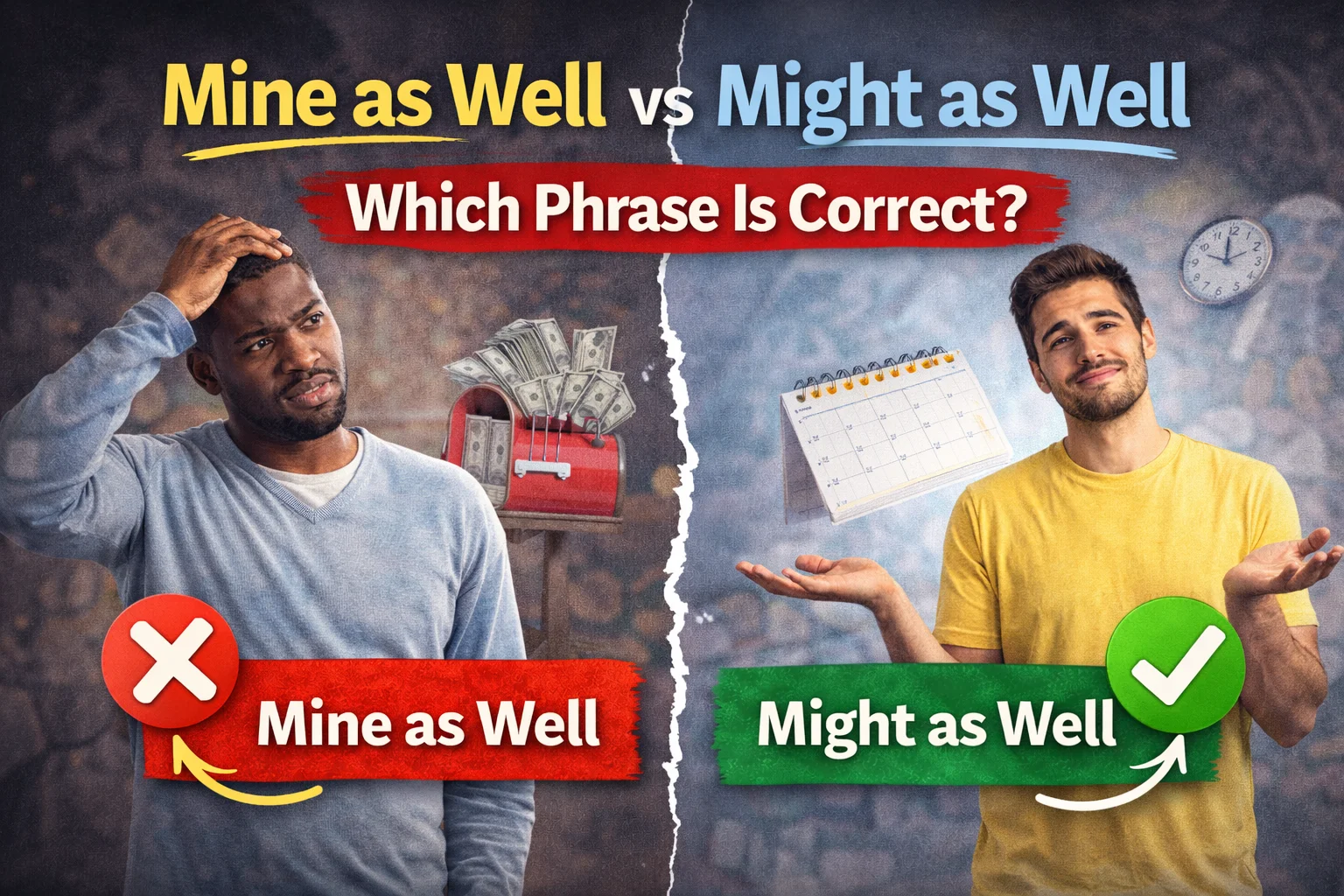
English has many phrases that sound similar but mean different things. One common example is Mine as Well or Might as Well. Many people hear these phrases in conversation and get confused about which one is correct.
If you have ever wondered whether mine as well is correct or if it should always be might as well, you are not alone. This mistake happens often because the phrases sound very similar when spoken quickly.
The truth is simple: “might as well” is the correct phrase, while “mine as well” is usually a misunderstanding of pronunciation. In casual speech, people may say it quickly, which makes it sound like “mine as well.”
In this guide, we will clearly explain the difference between Mine as Well or Might as Well, when to use the correct phrase, and why the confusion happens. You will also see easy examples, tips, and practical explanations that make this grammar rule simple to understand.
By the end of this article, you will feel confident using might as well correctly in everyday conversations and writing.
What Does “Might as Well” Mean?
The phrase might as well is commonly used in English to suggest that doing something is a reasonable choice when there are no better options.
It often expresses acceptance, practicality, or a casual decision. When someone says might as well, they usually mean that since nothing better is available, doing that action makes sense.
For example:
- “The movie starts in an hour. We might as well get some snacks.”
- “It’s raining outside. We might as well stay home.”
- “The store is nearby, so we might as well walk.”
In each example, the speaker suggests an action because it seems like the easiest or most logical option at the moment.
When discussing Mine as Well or Might as Well, remember that might as well is the standard and grammatically correct phrase. It appears in both spoken English and formal writing.
Understanding this meaning helps you avoid confusion and use the phrase naturally in everyday communication.
Is “Mine as Well” Ever Correct?
When discussing Mine as Well or Might as Well, many people wonder if mine as well can ever be correct.
In standard English grammar, mine as well is not correct when used in the same meaning as might as well. Most of the time, it is simply a spelling mistake or a misunderstanding of pronunciation.
People often hear someone say might as well quickly in conversation. Because the words blend together, it may sound like mine as well.
For example:
Incorrect:
- “We mine as well leave early.”
Correct:
- “We might as well leave early.”
However, the phrase mine as well could technically appear in a completely different sentence where mine refers to possession.
Example:
- “Your bag is heavy, but mine as well.”
In this case, mine refers to something that belongs to the speaker, and the sentence structure is different.
Still, in the grammar debate of Mine as Well or Might as Well, the phrase you should normally use is might as well.
Why People Confuse Mine as Well or Might as Well
The confusion between Mine as Well or Might as Well mainly comes from how the phrase sounds in everyday speech.
When people talk quickly, might as well often sounds like “mite-az-well.” This pronunciation can easily be misheard as mine as well, especially for language learners or young speakers.
Another reason is that English has many phrases that change slightly when spoken naturally. Words blend together, and listeners sometimes interpret them differently.
Here are a few reasons this confusion happens:
- Fast pronunciation makes words blend together.
- Similar sounds between “might” and “mine.”
- Learning English through conversation rather than writing.
- Autocorrect or typing mistakes in informal messages.
Because of these factors, the mix-up between Mine as Well or Might as Well appears frequently online and in casual communication.
Understanding this common mistake helps you avoid it and use the correct phrase confidently.
The Correct Way to Use “Might as Well”
To fully understand Mine as Well or Might as Well, it helps to know exactly how to use might as well correctly.
The phrase is usually followed by a base verb. It suggests doing something because it seems like the most practical option.
Structure:
Subject + might as well + base verb
Examples:
- “We might as well start the meeting now.”
- “I might as well finish my homework tonight.”
- “You might as well try the new restaurant.”
In these sentences, the speaker believes the action is the most reasonable choice.
The phrase often appears in casual conversations. However, it can also appear in writing when expressing informal reasoning or simple suggestions.
When comparing Mine as Well or Might as Well, remembering this structure makes it easier to identify the correct phrase.
Everyday Examples of “Might as Well”
Seeing examples makes grammar rules easier to understand. When learning the difference between Mine as Well or Might as Well, real-life examples are very helpful.
Here are some simple situations where might as well fits naturally.
Example 1
You finished work early and have free time.
Sentence:
“We might as well go for coffee.”
Example 2
A friend suggests watching a movie because nothing else is planned.
Sentence:
“We might as well watch that new show.”
Example 3
Someone decides to complete a task because they already started.
Sentence:
“I might as well finish the project today.”
Example 4
You are waiting somewhere with nothing to do.
Sentence:
“We might as well take a walk.”
These examples show how might as well helps people make relaxed decisions when options are limited.
Understanding these examples removes confusion when comparing Mine as Well or Might as Well.
Grammar Breakdown of “Might as Well”
To understand Mine as Well or Might as Well, it helps to look at the grammar behind the phrase.
The word might is a modal verb. Modal verbs express possibility, suggestion, or uncertainty. Other modal verbs include could, should, and may.
In the phrase might as well, the modal verb does not express uncertainty. Instead, it suggests a logical or practical choice.
For example:
- “You might as well call her.”
- “We might as well leave now.”
Here, the speaker is not unsure. They simply feel the action is reasonable.
This grammatical structure explains why mine as well is incorrect in most situations. The word mine is a possessive pronoun, not a modal verb.
That is why the correct phrase in the discussion of Mine as Well or Might as Well remains might as well.
Common Situations Where People Use “Might as Well”
Many everyday conversations include might as well because it expresses casual decisions.
People often use it in situations where they accept something or see no better option.
Here are common scenarios:
Waiting Situations
When people have free time while waiting.
Example:
“We might as well grab lunch while we wait.”
Limited Options
When choices are small or obvious.
Example:
“We might as well take the bus.”
Finishing Something
When someone decides to complete a task they started.
Example:
“I might as well finish cleaning today.”
Friendly Suggestions
When suggesting something without pressure.
Example:
“You might as well try the dessert.”
In each case, the phrase helps communication sound relaxed and natural.
Tips to Remember the Correct Phrase
Learning the difference between Mine as Well or Might as Well becomes easier with a few memory tricks.
Here are some helpful tips.
Think of Modal Verbs
Remember that might is a modal verb used for suggestions.
Check the Meaning
If the sentence suggests a logical decision, the phrase should be might as well.
Read the Sentence Out Loud
If mine as well sounds strange or confusing, it is probably incorrect.
Practice with Examples
Using the phrase in daily sentences helps build confidence.
Example practice:
- “We might as well start now.”
- “I might as well take the train.”
These tips make it easier to avoid the mistake when writing or speaking.
Similar Phrases in English
When exploring Mine as Well or Might as Well, it helps to look at similar expressions.
These phrases also suggest reasonable actions.
May as Well
This phrase is similar to might as well, though slightly less common.
Example:
“We may as well leave early.”
Could Just
This phrase offers another casual suggestion.
Example:
“We could just order pizza.”
Why Not
This phrase invites a suggestion.
Example:
“Why not watch a movie?”
Understanding these related expressions improves your conversational English.
Mistakes to Avoid When Using “Might as Well”
Even though might as well is simple, people sometimes misuse it.
Here are common mistakes.
Using “Mine as Well”
This is the most common error.
Incorrect:
“We mine as well try.”
Correct:
“We might as well try.”
Adding “To” Before the Verb
Incorrect:
“We might as well to go.”
Correct:
“We might as well go.”
Using It in Formal Writing
The phrase is mostly casual. In formal writing, clearer language may be better.
Example:
Casual:
“We might as well continue.”
Formal:
“It would be reasonable to continue.”
Avoiding these mistakes keeps your English accurate and clear.
Why This Phrase Matters in Everyday English
Understanding the difference between Mine as Well or Might as Well may seem small, but it improves communication.
Small grammar mistakes can affect how clearly ideas are understood. Using the correct phrase also makes writing appear more professional.
For students, professionals, and language learners, mastering small details like this builds stronger language skills.
In conversations, might as well also helps express casual decisions in a friendly way. It keeps communication simple and natural.
By learning the correct phrase now, you avoid a mistake that many English speakers make.
Frequently Asked Questions
1. Is “mine as well” ever correct?
In most cases, mine as well is incorrect. It usually comes from mishearing might as well.
2. What does “might as well” mean?
It means doing something because it seems like the best or easiest option.
3. Why do people say “mine as well”?
People hear might as well spoken quickly and mistakenly write it as mine as well.
4. Is “might as well” formal or informal?
The phrase is mostly used in casual conversation but can appear in informal writing.
5. Can “may as well” replace “might as well”?
Yes, may as well can sometimes replace it, though might as well is more common.
6. Is this mistake common in English?
Yes, many people confuse Mine as Well or Might as Well, especially in online messages.
Conclusion
The confusion between Mine as Well or Might as Well is very common, but the rule is simple. The correct phrase is might as well, and it is used to suggest doing something because it seems practical or logical.
The phrase mine as well usually appears because of pronunciation misunderstandings. When spoken quickly, might as well can sound similar, which leads to mistakes in writing.
By remembering that might is a modal verb and mine is a possessive pronoun, you can easily identify the correct phrase.
Learning small grammar differences like this improves both writing and conversation. It also helps you communicate more clearly and confidently.
So next time you face the choice between Mine as Well or Might as Well, you will know the correct answer right away: use “might as well.”