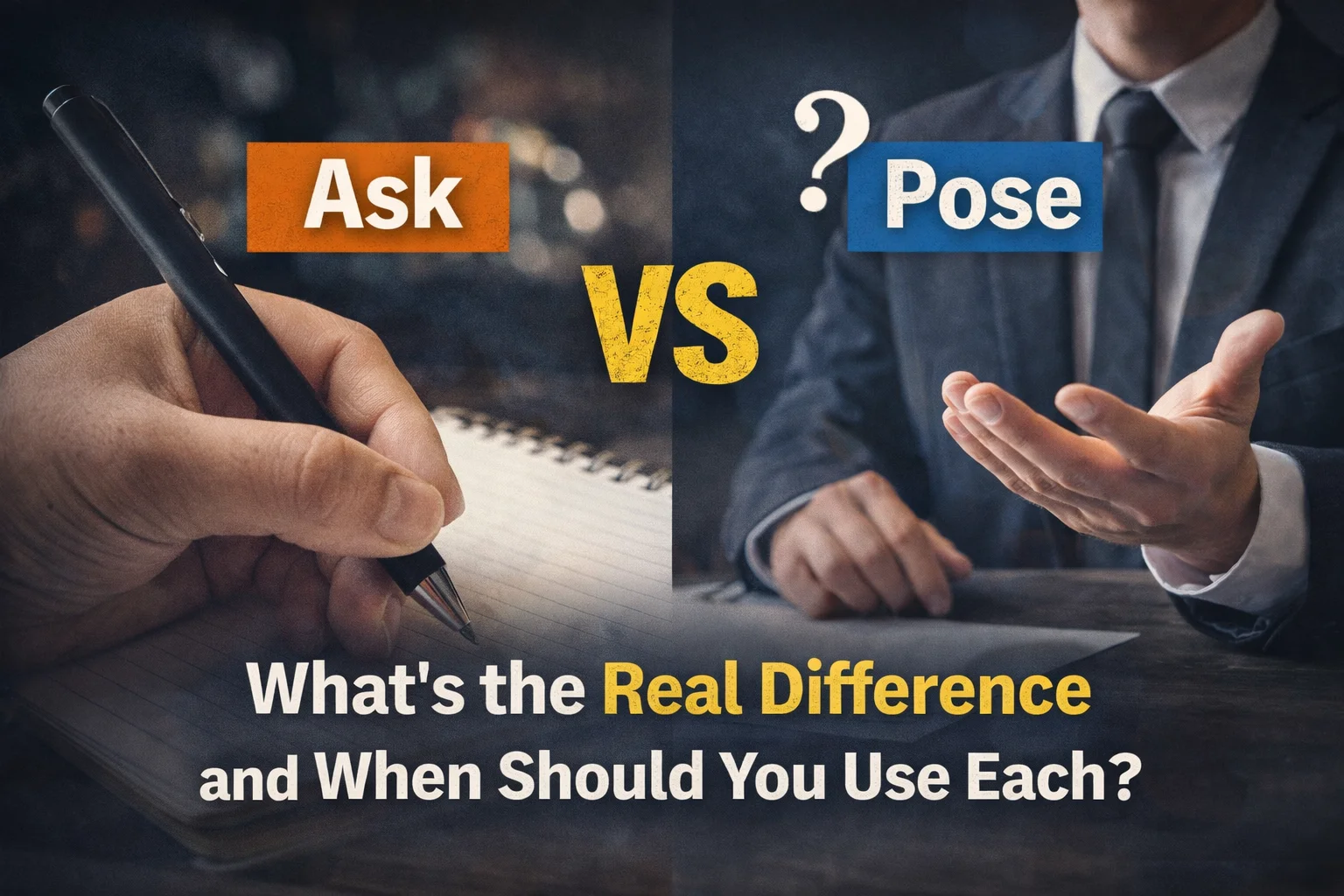
Words can look simple, yet they carry different shades of meaning. One common confusion is Ask vs Pose. Both relate to questions, but they are not always used the same way. Understanding this difference helps you speak and write more clearly.
In daily conversations, people often say ask a question. But in formal writing or interviews, you may hear someone pose a question. Both sound correct, yet they feel slightly different.
This guide will explain Ask vs Pose in a very simple way. You will learn what each word means, how to use them, and when one works better than the other. We will also look at examples, tips, and common mistakes.
By the end, you will feel confident choosing the right word in any situation.
What Does “Ask” Mean?
The word ask is one of the most common verbs in English. It means to request information, help, or permission from someone. When you ask something, you want an answer or response.
For example, a student may ask a teacher a question during class. A child may ask a parent for permission. In both cases, the speaker expects a reply.
Because it is simple and direct, ask is used in everyday conversation. People ask questions, ask for help, or ask for advice many times each day.
Here are a few clear examples:
- I asked the teacher about the homework.
- She asked for a glass of water.
- They asked us to join the meeting.
Notice how natural the word sounds. That is why ask is the most common choice in casual communication.
When people compare Ask vs Pose, they usually notice that ask feels friendly, direct, and informal.
What Does “Pose” Mean?
The word pose has several meanings in English, but in this topic it means to present or raise a question or problem. When someone poses a question, they are introducing it for discussion or thought.
Unlike ask, the word pose sounds more formal and thoughtful. It often appears in academic writing, speeches, or interviews.
For example:
- The professor posed a difficult question to the class.
- The article poses an important problem about climate change.
- The interviewer posed several challenging questions.
In these examples, the speaker is not simply asking for information. Instead, they are presenting a question for people to consider carefully.
This difference is important when understanding Ask vs Pose. Ask seeks a response, while pose often introduces a topic or challenge.
Ask vs Pose: The Core Difference
The difference between Ask vs Pose is mainly about tone and purpose.
The word ask focuses on getting an answer. It is direct and common in everyday speech. People ask questions when they want information quickly.
The word pose, however, focuses on presenting a question or idea. It often invites deeper thinking rather than a quick reply.
Think of it this way:
- Ask = request information
- Pose = present a question or challenge
For example:
- A student asks the teacher a question.
- A philosopher poses a deep question about life.
Both sentences involve questions, but the tone changes. That is the key idea behind Ask vs Pose.
Understanding this difference helps you choose the right word in the right situation.
Everyday Situations Where “Ask” Works Best
In most daily conversations, ask is the better choice. It is simple, natural, and easy for everyone to understand.
People use ask when they want something specific. It might be information, help, or permission.
Here are common situations where ask fits perfectly:
- Asking for directions
- Asking a friend for help
- Asking a teacher a question
- Asking a colleague about a project
For example:
- I asked him where the station is.
- She asked the manager for advice.
- We asked the guide about the museum.
Using ask keeps communication clear and friendly. That is why it appears so often in everyday language.
When learning Ask vs Pose, remember that ask is usually the safest and most natural option.
Situations Where “Pose” Sounds Better
Although ask is common, there are times when pose sounds more suitable. This happens mostly in formal or thoughtful contexts.
Writers, researchers, and speakers often use pose when introducing an idea or problem.
For example, an article may pose a question like:
How can cities reduce pollution in the future?
Here, the writer is not expecting one quick answer. Instead, the question opens a discussion.
Here are situations where pose is often used:
- Academic writing
- Research papers
- Speeches and debates
- Interviews
- Thought-provoking discussions
For example:
- The scientist posed an interesting theory.
- The journalist posed several tough questions.
- The teacher posed a puzzle to the class.
In these cases, pose sounds more thoughtful than ask. That is another key difference in Ask vs Pose.
Ask vs Pose in Professional Writing
Professional writing often requires careful word choice. That is where understanding Ask vs Pose becomes helpful.
Business emails, reports, and articles may use both words depending on the tone.
For example, in a meeting you might say:
“I would like to ask a question about the project timeline.”
This sentence sounds polite and clear.
However, in a report you may write:
“This research poses an important question about data privacy.”
Here the word pose introduces a topic rather than requesting a reply.
Professional writers use this distinction to sound precise and thoughtful. Choosing the right word improves clarity and credibility.
Examples to Understand Ask vs Pose
Looking at examples is one of the best ways to understand Ask vs Pose. The sentences below show how the two words work in real situations.
Simple Everyday Examples
- I asked my neighbor about the noise.
- She asked the doctor for advice.
- We asked the teacher about the test.
These sentences feel natural in everyday speech.
More Formal Examples
- The researcher posed a difficult question.
- The speaker posed an interesting challenge.
- The article poses a serious problem.
In these sentences, the question is introduced for thought or discussion.
Seeing these examples side by side helps clarify the difference between Ask vs Pose.
Common Mistakes People Make
Many learners mix up Ask vs Pose because both involve questions. However, using the wrong word can make a sentence sound unusual.
One common mistake is using pose in casual conversation.
For example:
“Can I pose you a question?”
While not completely wrong, it sounds overly formal. Most people would simply say:
“Can I ask you a question?”
Another mistake is using ask in formal writing where pose would sound better.
For example:
“This research asks an important question.”
It is understandable, but many writers prefer:
“This research poses an important question.”
Learning these small differences makes your English sound more natural and polished.
Tips to Remember the Difference
Remembering Ask vs Pose becomes easy with a few simple tips.
First, think about the goal of your question. If you want a quick answer, use ask. If you want people to think deeply, use pose.
Second, consider the situation. Everyday conversations usually use ask. Formal discussions often use pose.
Third, read the sentence out loud. If it sounds too formal for the situation, choose ask instead.
Finally, practice using both words in your own sentences. The more you use them, the easier the difference becomes.
These simple tips can help anyone master Ask vs Pose quickly.
Why Understanding Ask vs Pose Matters
Learning the difference between Ask vs Pose improves both speaking and writing skills.
Clear word choice helps people understand your ideas faster. It also makes your writing sound more professional and thoughtful.
For example, students writing essays often need to introduce questions or problems. Using pose can make their writing stronger.
At the same time, using ask keeps everyday communication friendly and simple.
Knowing when to use each word shows strong language awareness. It also builds confidence when communicating in English.
Quick Comparison Table
| Feature | Ask | Pose |
|---|---|---|
| Tone | Casual and everyday | Formal and thoughtful |
| Purpose | Request information | Present a question or problem |
| Common Use | Conversations, requests | Academic writing, discussions |
| Example | Ask a teacher a question | Pose a philosophical question |
This table makes the difference between Ask vs Pose easier to remember.
FAQs About Ask vs Pose
1. Are “ask” and “pose” interchangeable?
Not always. Both relate to questions, but they have different tones. Ask is casual, while pose is more formal and thoughtful.
2. Can I say “pose a question”?
Yes, that phrase is common in formal contexts. Writers and speakers often pose a question to start a discussion.
3. Is “ask a question” more common?
Yes. In everyday English, people almost always ask a question instead of saying pose a question.
4. Can “pose” be used in everyday conversation?
It can be used, but it may sound formal. Most people prefer ask in casual speech.
5. Do teachers pose questions or ask questions?
Both are possible. Teachers usually ask questions in class. However, textbooks or lectures may say teachers pose questions.
6. Why do writers prefer “pose”?
Writers often use pose because it introduces ideas for deeper thinking rather than just requesting answers.
Final Thoughts on Ask vs Pose
Understanding Ask vs Pose is a small step that can greatly improve your English communication. Both words relate to questions, yet they serve slightly different purposes.
The word ask is simple, direct, and common in daily conversation. People use it when they want answers, help, or information. It keeps communication friendly and clear.
The word pose, on the other hand, feels more formal and thoughtful. It is often used in academic writing, speeches, and discussions. Instead of seeking a quick reply, it introduces a question or challenge for people to consider.
When choosing between Ask vs Pose, think about the situation and your goal. If you want an answer, ask. If you want to introduce an idea, pose.
With practice, this choice will become natural. Soon you will use both words with confidence and clarity.