Many English words look almost the same but carry slightly different meanings. One pair that often confuses writers is Entwined vs Intertwined. At first glance, both words appear identical in meaning. They both describe things twisted, wrapped, or connected together.
Because of this similarity, many people use them interchangeably. In everyday conversations, that usually works fine. However, when writing carefully, small differences in meaning and tone start to matter.
Understanding Entwined vs Intertwined helps you choose the best word for the situation. One word may sound more poetic and emotional, while the other may sound more structured or complex.
In this guide, we will explore the meanings, differences, examples, and common mistakes related to these two words. You will also see practical examples and helpful tips to remember when each word works best.
By the end of this article, you will clearly understand Entwined vs Intertwined and feel confident using them correctly in writing and conversation.
Understanding the Basics of Entwined vs Intertwined
To understand Entwined vs Intertwined, it helps to start with the root word twine. The word twine means to twist or wrap something around another object.
Both entwined and intertwined come from this same root. That is why their meanings are so similar.
However, the prefixes change the meaning slightly.
- En- suggests wrapping or surrounding something.
- Inter- means “between” or “among.”
Because of this, the two words can create different images in a reader’s mind. One may suggest a simple connection. The other may suggest many layers connected together.
The table below shows the basic difference between the two words.
| Word | Basic Meaning | Tone | Typical Use |
|---|---|---|---|
| Entwined | Wrapped or twisted together | Soft, poetic | Relationships, nature |
| Intertwined | Twisted together with multiple connections | Complex, structured | Systems, ideas, relationships |
This simple comparison makes it easier to understand the subtle difference in Entwined vs Intertwined.
What Does “Entwined” Mean?
The word entwined describes something gently wrapped or twisted around another object. The connection often feels smooth, graceful, or natural.
You may see entwined used in literature, poetry, and storytelling. Writers choose this word when they want to create a soft or emotional image.
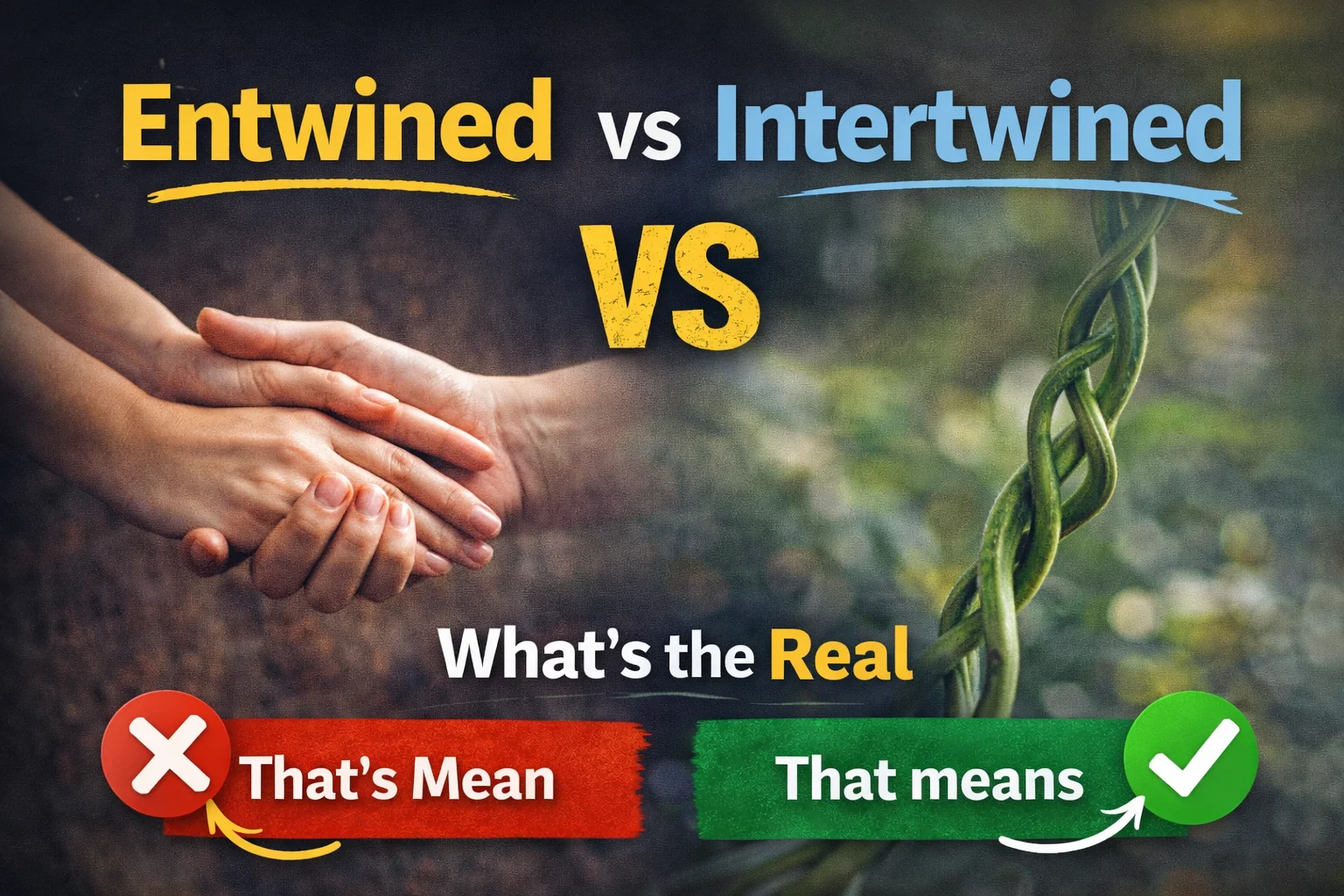
Imagine two vines growing on a garden fence. Over time, they twist around each other slowly. In that situation, the vines are entwined.
Examples include:
- Their fingers were entwined as they watched the sunset.
- The flowers were entwined around the garden arch.
- Their memories became entwined over many years.
Notice how these examples feel gentle and personal.
In discussions about Entwined vs Intertwined, many writers describe entwined as the more romantic or poetic option.
It focuses more on closeness rather than complexity.
What Does “Intertwined” Mean?
The word intertwined also describes things twisted together. However, the connection usually involves more parts or layers.
The prefix inter- suggests interaction between several elements.
Imagine multiple ropes wrapped tightly together. Each rope crosses over and under the others. This creates a stronger and more complex structure.
Examples include:
- The tree branches were intertwined above the path.
- History and culture are deeply intertwined.
- Their business interests became intertwined.
Here, the word suggests something difficult to separate.
When comparing Entwined vs Intertwined, many writers use intertwined when describing systems, networks, or complex relationships.
Key Differences Between Entwined vs Intertwined
Although the meanings overlap, the two words often carry slightly different tones.
The table below highlights the main differences clearly.
| Feature | Entwined | Intertwined |
|---|---|---|
| Level of connection | Simple or gentle | Complex or layered |
| Tone | Emotional or poetic | Analytical or descriptive |
| Number of elements | Usually two things | Often multiple things |
| Writing style | Literary and romantic | Informational or academic |
These differences help writers decide which word fits best in a sentence.
Understanding this distinction makes the comparison of Entwined vs Intertwined much clearer.
Entwined vs Intertwined in Physical Descriptions
Both words often appear when describing objects in nature or everyday life.
For example, plants and vines frequently twist around structures or other plants.
If two vines simply wrap around each other, the word entwined works well.
However, if many branches cross over each other in complex patterns, intertwined may sound more accurate.
Consider these examples:
- Roses grew entwined around the wooden gate.
- Roots became intertwined beneath the soil.
- The couple walked with their hands entwined.
- Cables behind the desk became intertwined.
In these situations, the difference between Entwined vs Intertwined becomes easier to visualize.
Entwined vs Intertwined in Emotional Contexts
Language often uses physical words to describe emotions. The same happens with Entwined vs Intertwined.
Entwined usually appears in emotional or romantic descriptions. It suggests closeness and affection.
For example:
- Their lives became entwined after marriage.
- Love and trust were entwined in their story.
Intertwined, however, may describe deeper connections that involve multiple factors.
Examples include:
- Their families became deeply intertwined.
- Their careers were intertwined for decades.
This subtle difference explains why the discussion around Entwined vs Intertwined appears often in writing guides.
Examples of Entwined vs Intertwined in Sentences
Examples make language rules easier to understand. The table below shows practical sentences using both words.
| Sentence Type | Example with Entwined | Example with Intertwined |
|---|---|---|
| Nature | Ivy grew entwined around the tree. | Roots were intertwined underground. |
| Romance | Their fingers stayed entwined. | Their lives became intertwined over time. |
| Ideas | Dreams and hopes were entwined in her story. | Politics and culture are intertwined. |
| Objects | Ribbons were entwined in her hair. | Wires became intertwined behind the desk. |
Seeing these examples makes the concept of Entwined vs Intertwined much easier to grasp.
Why People Confuse Entwined vs Intertwined
The confusion between Entwined vs Intertwined happens for several reasons.
First, both words share the same root word twine. This makes them sound and look almost identical.
Second, dictionaries sometimes list them as synonyms. This suggests they can replace each other freely.
Third, the differences are subtle rather than strict grammar rules.
Because of this, many native speakers use both words without thinking too much about the distinction.
However, writers who want precise language often consider tone, imagery, and context when choosing between them.
Learning these small details can make your writing clearer and more expressive.
Common Mistakes When Using Entwined vs Intertwined
Writers sometimes make small mistakes when choosing between these words.
One mistake is using entwined to describe complicated systems. In those cases, intertwined usually sounds more natural.
Another mistake is avoiding one word completely because it feels confusing.
The table below highlights some common mistakes and corrections.
| Mistake | Better Choice | Explanation |
|---|---|---|
| Their business networks are entwined | Intertwined | Multiple complex connections |
| The lovers held intertwined hands | Entwined | Romantic imagery |
| The vines are intertwined softly | Entwined | Gentle wrapping |
Understanding these small adjustments helps clarify Entwined vs Intertwined usage.
Quick Tips to Remember the Difference
Remembering word differences becomes easier with simple tricks.
Here are some helpful tips:
- Think of inter- as meaning between many things.
- Use intertwined when many parts connect together.
- Use entwined when two things wrap gently together.
- If the sentence sounds romantic, entwined often fits better.
- If the sentence describes systems or networks, intertwined usually works best.
These quick tips make it easier to remember the difference between Entwined vs Intertwined in everyday writing.
FAQs About Entwined vs Intertwined
1. Are entwined and intertwined the same?
They are very similar but not identical. Both describe things twisted together. However, intertwined usually suggests more complexity.
2. Can the words be used interchangeably?
Yes, in many cases they can. Most readers will understand either word. Still, tone and context may change slightly.
3. Which word sounds more poetic?
Entwined often sounds more poetic or romantic. Writers commonly use it in storytelling or literature.
4. Is intertwined more formal?
Yes, intertwined often appears in academic or analytical writing when describing systems or relationships.
5. Which word is more common?
Both words are common in English, but intertwined appears slightly more in formal contexts.
6. How can I remember the difference easily?
Think of the prefix inter- meaning “between many things.” This reminds you that intertwined often involves multiple connections.
Conclusion
Understanding Entwined vs Intertwined may seem like a small detail, but it can improve your writing significantly.
Both words describe things twisted or connected together. However, the tone and depth of the connection can differ.
Entwined usually suggests a gentle, emotional, or poetic connection. It works well in romantic descriptions, storytelling, and imagery.
Intertwined, on the other hand, often describes deeper or more complex relationships. It fits better when discussing systems, ideas, or networks.
In many cases, the two words can replace each other without causing confusion. Still, choosing the right one can add clarity and style to your writing.
The best way to master Entwined vs Intertwined is through practice. Pay attention to how these words appear in books, articles, and conversations.
Over time, selecting the right word will feel natural and effortless.