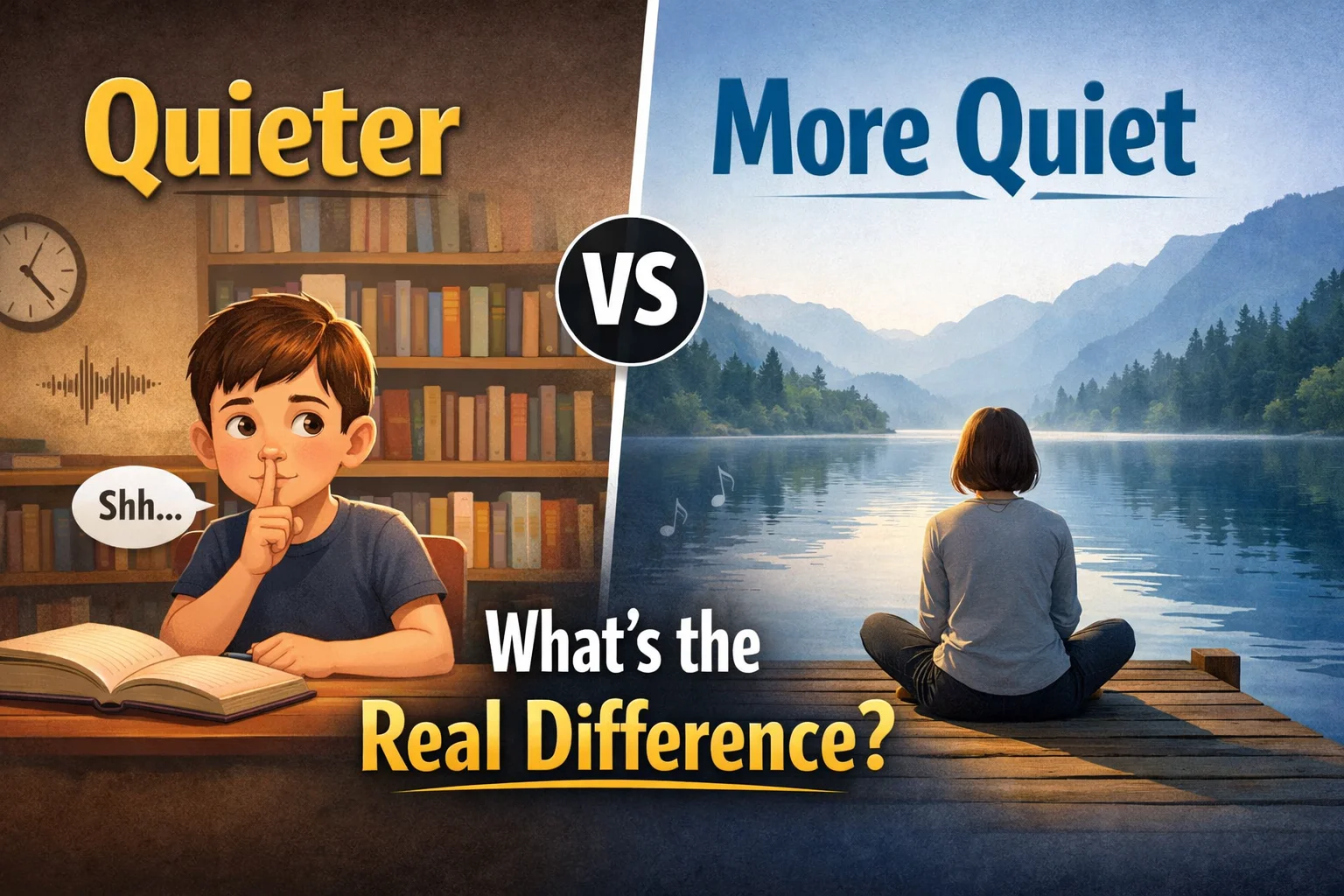
Language can be funny sometimes. Two phrases can mean almost the same thing but still sound different. A great example is “quieter vs more quiet.” Many people are unsure which one to use. Both seem correct, yet one often feels more natural.
If you have ever paused while writing and wondered which phrase fits better, you are not alone. English learners, writers, and even native speakers ask this question often.
In this guide, we will explore quieter vs more quiet in a simple and friendly way. You will learn the real difference, when to use each phrase, and why grammar rules prefer one over the other. By the end, you will feel confident choosing the right phrase every time.
Understanding the Basics of Comparative Adjectives
Before diving into quieter vs more quiet, we need to understand something called comparative adjectives.
Comparative adjectives help us compare two things. They show that one thing has more or less of a quality than another.
For example:
- A library is quieter than a classroom.
- My phone is faster than my old laptop.
- This road is longer than the other one.
In many cases, we add “-er” to the end of a short adjective to form the comparison.
Quiet → Quieter
However, sometimes we use “more” before the adjective instead.
For example:
- Beautiful → More beautiful
- Interesting → More interesting
This rule is important when comparing quieter vs more quiet, because both phrases try to show comparison.
What Does “Quieter” Mean?
The word quieter is the comparative form of the adjective quiet. It simply means less noisy or more peaceful than something else.
Examples:
- The park is quieter in the morning.
- This new fan is quieter than the old one.
- The second classroom is quieter than the first.
In everyday English, quieter is the most natural and common way to compare levels of noise.
When people talk about quieter vs more quiet, grammar experts almost always prefer quieter.
That is because quiet is a short adjective with one syllable. Short adjectives usually take “-er” to form comparisons.
So in most cases, quieter is the correct choice.
What Does “More Quiet” Mean?
Now let’s look at the other side of quieter vs more quiet.
The phrase more quiet also means less noisy compared to something else. However, it follows a different structure.
Instead of changing the adjective itself, we add “more” before it.
Example:
- The office became more quiet after everyone left.
Even though this sentence makes sense, it sounds a little unusual to native speakers.
That is because English normally uses “-er” with short adjectives.
So when comparing quieter vs more quiet, the second option is usually less natural.
However, that does not mean it is always wrong.
Why “Quieter” Is Usually Preferred
In most grammar guides, quieter wins in the debate of quieter vs more quiet.
Here is the simple rule:
- Short adjectives → add “-er”
- Long adjectives → use “more”
Examples of short adjectives:
- tall → taller
- fast → faster
- quiet → quieter
Examples of longer adjectives:
- beautiful → more beautiful
- expensive → more expensive
- comfortable → more comfortable
Because quiet has only one syllable, the natural comparative form becomes quieter.
That is why teachers, editors, and style guides recommend using quieter in most situations.
When “More Quiet” Might Be Used
Even though quieter is preferred, more quiet can still appear in certain contexts.
Sometimes writers choose more quiet for emphasis or style. It can sound slightly softer or more reflective.
Example:
- After the children left, the house felt more quiet than usual.
In creative writing, this phrasing may create a certain tone or rhythm.
Another reason is speech patterns. Some people naturally say more quiet when speaking casually.
So when discussing quieter vs more quiet, remember that language is flexible. Rules guide us, but real usage can vary.
Examples of Quieter in Everyday Sentences
To better understand quieter vs more quiet, let’s look at common sentences using quieter.
Examples:
- This neighborhood is quieter at night.
- My new keyboard is much quieter than the old one.
- The library is quieter during exam season.
- Please speak quieter in the hallway.
- The countryside is quieter than the city.
These examples show how natural the word quieter sounds in daily conversations.
Because it follows normal grammar rules, it feels smooth and easy to understand.
That is why most grammar experts strongly favor quieter when comparing noise levels.
Examples of More Quiet in Context
Now let’s look at a few examples where more quiet appears.
Examples:
- The house became more quiet after midnight.
- The room felt more quiet once the music stopped.
- The town seemed more quiet during winter.
These sentences are understandable, but they sound slightly less natural.
When comparing quieter vs more quiet, readers may notice the difference right away.
Still, the meaning remains clear. That is why some writers still use it occasionally.
Common Mistakes People Make
Many people confuse quieter vs more quiet because they try to follow different grammar rules at the same time.
Here are some common mistakes:
1. Using Both Together
Incorrect example:
- This room is more quieter than the other.
This sentence is wrong because it uses two comparison forms at once.
Correct versions:
- This room is quieter than the other.
- This room is more quiet than the other.
2. Overthinking Simple Comparisons
Sometimes writers avoid quieter because it feels too simple. They choose more quiet thinking it sounds more formal.
However, the simple version is usually the best choice.
Quieter vs More Quiet in Formal Writing
In formal writing, editors and grammar guides strongly prefer quieter.
This includes:
- Academic papers
- Blog posts
- News articles
- Business writing
Using quieter keeps sentences smooth and grammatically clean.
For example:
- The newer model operates quieter than the previous version.
When discussing quieter vs more quiet in professional writing, the shorter comparative form is almost always recommended.
Quieter vs More Quiet in Everyday Speech
Speech is often more relaxed than formal writing.
Some people casually say more quiet without thinking about grammar rules.
Example:
- Can you be more quiet please?
Even though the sentence works, most people would naturally say:
- Can you be quieter please?
This shows how common quieter is in everyday conversation.
Helpful Tips to Remember the Difference
If you ever forget the rule for quieter vs more quiet, here are a few simple tips.
Tip 1: If the adjective is short, add “-er.”
Example:
quiet → quieter
Tip 2: If the adjective is long, use “more.”
Example:
beautiful → more beautiful
Tip 3: Avoid using both forms together.
Incorrect: more quieter
Correct: quieter
These small tips make it easy to choose the right phrase quickly.
Why This Grammar Question Matters
At first glance, quieter vs more quiet may seem like a tiny grammar detail. But small details can improve writing a lot.
Clear grammar helps readers understand your message faster. It also makes your writing look more professional.
Writers, bloggers, and students often pay attention to these details because they build trust with readers.
Even simple grammar choices can shape how polished your writing feels.
FAQs About Quieter vs More Quiet
1. Which is correct: quieter or more quiet?
Both can be correct, but quieter is usually preferred. It follows normal grammar rules for short adjectives.
2. Why does quieter sound more natural?
Because quiet is a one-syllable adjective. English normally forms comparisons by adding “-er.”
3. Is “more quiet” grammatically wrong?
No, it is not strictly wrong. However, it sounds less natural in most situations.
4. Can I use “more quiet” in creative writing?
Yes. Writers sometimes use more quiet to create a certain tone or rhythm.
5. What is the biggest mistake with these phrases?
The biggest mistake is saying “more quieter.” This mixes two comparison forms and is incorrect.
6. Which form should students use in essays?
Students should usually choose quieter because it follows standard grammar rules.
Conclusion
The difference between quieter vs more quiet is simpler than it first appears. Both phrases aim to compare levels of noise, but English grammar prefers one form over the other.
Because quiet is a short adjective, the natural comparative form is quieter. This is the version most commonly used in writing and speech. It sounds smoother and follows standard grammar patterns.
The phrase more quiet can still appear in some situations, especially in casual speech or creative writing. However, it is less common and may sound slightly unusual.
If you want to stay safe and clear in your writing, choosing quieter is usually the best option.
Language is always evolving, but understanding small grammar details like quieter vs more quiet helps you write with confidence, clarity, and style.