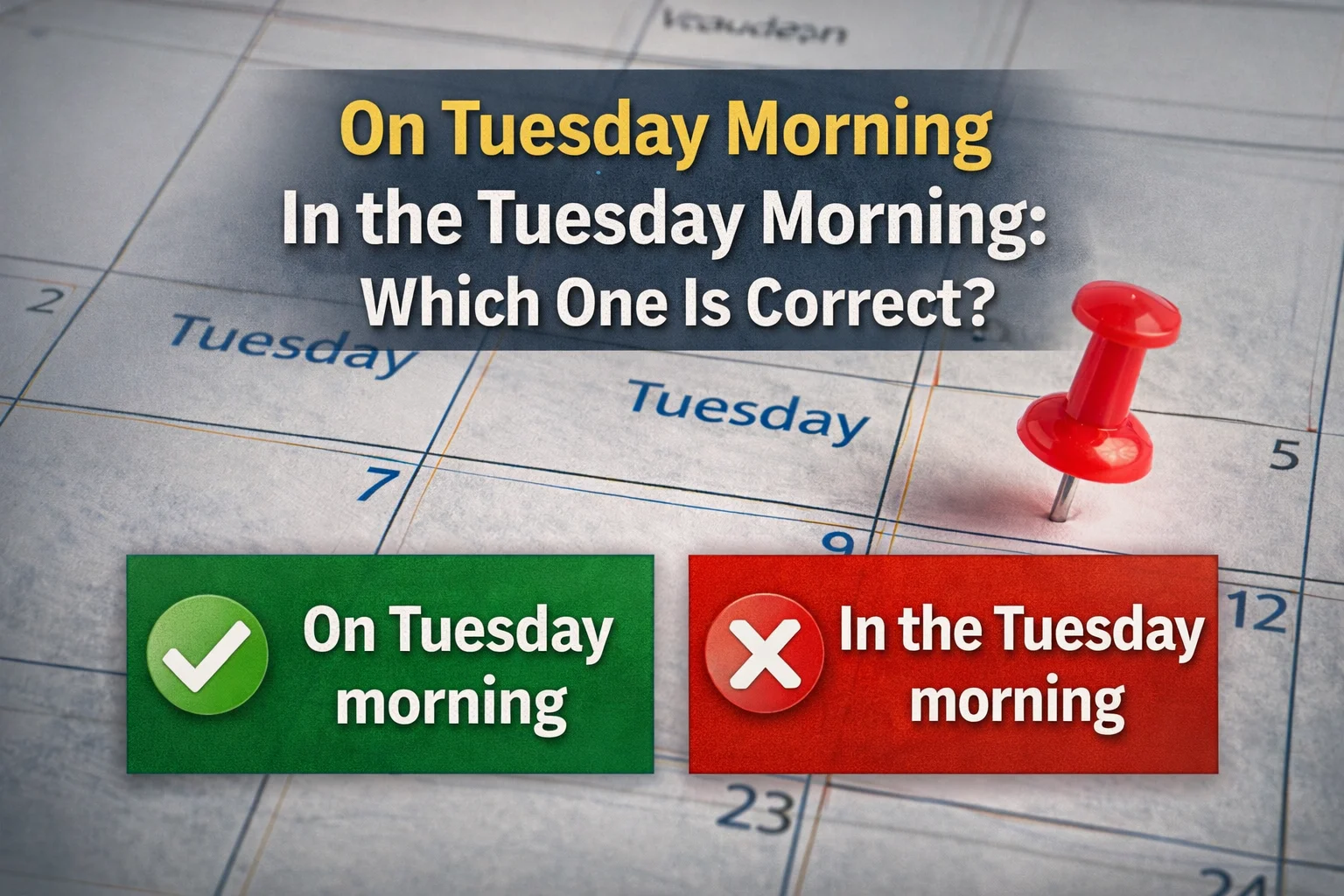
Many English learners feel confused about time phrases. One common question is “On Tuesday Morning or In the Tuesday Morning?” 🤔
Both phrases look similar, but only one sounds natural in everyday English. Small grammar choices like this can change how clear your sentence feels.
In most situations, native speakers say “on Tuesday morning.” The phrase “in the Tuesday morning” sounds strange and is rarely used. Understanding the correct form helps you speak and write more naturally.
This guide will explain the difference between “On Tuesday Morning or In the Tuesday Morning” in a simple way. You will learn why one form works and the other does not. We will also look at examples, rules, and tips to help you remember the correct phrase.
By the end of this article, you will feel confident using time expressions like on Tuesday morning, on Monday afternoon, and on Friday night. Let’s begin.
Understanding the Difference Between “On Tuesday Morning or In the Tuesday Morning”
The main difference between “On Tuesday Morning or In the Tuesday Morning” comes from how English uses prepositions with time.
In English grammar, different prepositions work with different types of time expressions. For example:
- On is used with specific days.
- In is used with months, years, and general time periods.
- At is used with exact times.
Tuesday is a specific day, so we normally use on.
Examples:
- I have a meeting on Tuesday morning.
- We will travel on Tuesday morning.
- She called me on Tuesday morning.
The phrase “in the Tuesday morning” sounds unnatural because the word Tuesday already makes the time specific. Native speakers do not add “the” in this case.
So when thinking about On Tuesday Morning or In the Tuesday Morning, remember this simple rule:
👉 Use on Tuesday morning, not in the Tuesday morning.
Why “On Tuesday Morning” Is the Correct Form
English uses on for specific days and dates. Tuesday is a named day, so on fits perfectly.
When we say on Tuesday morning, we refer to a specific part of that day.
Examples:
- The exam starts on Tuesday morning.
- I will send the report on Tuesday morning.
- The train leaves on Tuesday morning.
Notice how natural these sentences feel.
The phrase in the Tuesday morning feels awkward because English speakers do not normally combine in + the + weekday morning.
So when deciding between On Tuesday Morning or In the Tuesday Morning, the correct and natural choice is on Tuesday morning.
When We Use “In the Morning”
Now you may wonder why “in the morning” is correct. That is a good question.
The phrase in the morning describes a general time period, not a specific day.
Examples:
- I like to exercise in the morning.
- Birds sing loudly in the morning.
- I drink coffee in the morning.
Here, the time is general. We do not mention a specific day.
But once we add a day like Tuesday, the grammar changes.
Correct:
- I go jogging on Tuesday morning.
Not natural:
- I go jogging in the Tuesday morning.
So the difference between On Tuesday Morning or In the Tuesday Morning depends on whether the time is specific or general.
How English Prepositions Work With Time
Learning prepositions can make English much easier. Here is a simple guide.
At – Exact times
Use at for precise times.
Examples:
- The meeting starts at 9 AM.
- I wake up at 7 AM.
On – Specific days
Use on for days and dates.
Examples:
- The party is on Saturday.
- I will travel on Tuesday morning.
In – Longer periods
Use in for months, years, and general times.
Examples:
- I was born in 2000.
- Flowers bloom in spring.
When choosing between On Tuesday Morning or In the Tuesday Morning, the day Tuesday makes the phrase specific. That is why on is correct.
Examples of “On Tuesday Morning” in Sentences
Examples help grammar feel easier. Here are some natural sentences using on Tuesday morning.
- Our team meeting is on Tuesday morning.
- The doctor appointment is on Tuesday morning.
- She arrived early on Tuesday morning.
- We will start the project on Tuesday morning.
- The package came on Tuesday morning.
Each example sounds smooth and natural.
Notice how English speakers use this phrase in daily life. It appears in work emails, conversations, and schedules.
When deciding between On Tuesday Morning or In the Tuesday Morning, these examples clearly show the correct choice.
Why “In the Tuesday Morning” Sounds Unnatural
The phrase in the Tuesday morning breaks a common grammar pattern.
English speakers rarely place “the” before weekday mornings.
Incorrect forms include:
- in the Monday morning
- in the Tuesday morning
- in the Friday morning
These phrases sound unusual to native speakers.
Instead, English prefers this pattern:
- on Monday morning
- on Tuesday morning
- on Friday morning
Because of this rule, On Tuesday Morning or In the Tuesday Morning is not really a close competition. The correct option is clearly on Tuesday morning.
Similar Time Expressions You Should Know
Understanding similar phrases will strengthen your grammar.
Here are common patterns used in English:
| Correct Expression | Example Sentence |
|---|---|
| On Monday morning | I met him on Monday morning. |
| On Wednesday afternoon | The meeting is on Wednesday afternoon. |
| On Friday night | The show starts on Friday night. |
| In the morning | I feel fresh in the morning. |
| In the evening | We relax in the evening. |
This table shows how the preposition changes depending on the time type.
Again, when choosing between On Tuesday Morning or In the Tuesday Morning, the correct pattern follows on + day + time of day.
Real-Life Situations Where You Use “On Tuesday Morning”
You may use this phrase often in real life.
Here are common situations.
Work schedules
Managers often schedule meetings on Tuesday morning.
Example:
“Our weekly planning meeting is on Tuesday morning.”
School activities
Teachers may announce tests on Tuesday morning.
Example:
“The science exam will happen on Tuesday morning.”
Travel plans
Flights and buses may leave on Tuesday morning.
Example:
“Our flight departs on Tuesday morning.”
These everyday examples make the phrase easy to remember.
Tips to Remember the Correct Phrase
Grammar becomes easier with small memory tricks. Here are a few helpful tips.
Tip 1: Think of Tuesday as a day
Days always use on.
Example:
- on Tuesday
- on Wednesday
- on Sunday
Tip 2: Add morning, afternoon, or night
When you combine them with days, keep on.
Examples:
- on Tuesday morning
- on Thursday afternoon
- on Saturday night
Tip 3: Use “in” only for general times
Examples:
- in the morning
- in the afternoon
- in the evening
If you remember these tips, the confusion between On Tuesday Morning or In the Tuesday Morning will disappear quickly.
Common Grammar Mistakes With Time Expressions
Many learners make similar mistakes with time phrases. Let’s look at a few.
Incorrect:
- I will call you in Tuesday morning.
Correct:
- I will call you on Tuesday morning.
Incorrect:
- She arrived in the Monday morning.
Correct:
- She arrived on Monday morning.
Incorrect:
- The class begins in Tuesday afternoon.
Correct:
- The class begins on Tuesday afternoon.
Avoiding these mistakes will make your English sound more natural and confident.
Why Native Speakers Prefer “On Tuesday Morning”
Language grows through habits and patterns. Native speakers follow common grammar patterns automatically.
The pattern on + weekday + part of day is widely used.
Examples include:
- on Tuesday morning
- on Monday afternoon
- on Friday evening
Because this structure is common, it feels natural in conversation and writing.
So when deciding between On Tuesday Morning or In the Tuesday Morning, the correct phrase matches the pattern used by millions of English speakers.
How This Rule Improves Your English Writing
Using correct prepositions improves both clarity and professionalism.
For example, imagine a work email.
Incorrect:
“Let’s meet in the Tuesday morning.”
Correct:
“Let’s meet on Tuesday morning.”
The second sentence sounds more natural and professional.
Small grammar details like this help readers trust your writing. They also make your message easier to understand.
Frequently Asked Questions
Is “On Tuesday Morning” grammatically correct?
Yes. On Tuesday morning is the correct and natural phrase. It follows the rule of using on with specific days.
Why is “In the Tuesday Morning” incorrect?
The phrase sounds unnatural because English does not use in + the + weekday morning. Native speakers prefer on Tuesday morning.
Can we say “In the Morning on Tuesday”?
Yes, but it is less common. Most people simply say on Tuesday morning.
Do we always use “on” with days?
Yes. English grammar usually uses on with days and dates, such as on Monday, on Tuesday, and on Friday night.
Is “On Tuesday Morning” formal or informal?
It works in both formal and informal English. You can use it in emails, conversations, and writing.
Can I say “Tuesday Morning” without a preposition?
Yes, sometimes. For example:
“Tuesday morning will be busy.”
But in most sentences, on Tuesday morning is clearer.
Conclusion
Understanding On Tuesday Morning or In the Tuesday Morning is simple once you know the rule.
English uses on with specific days. That is why on Tuesday morning is the correct phrase.
The form in the Tuesday morning sounds unnatural and is rarely used by native speakers.
To remember the rule, keep this pattern in mind:
- On + day + part of the day
Examples include:
- on Monday morning
- on Tuesday afternoon
- on Friday night
Learning small grammar details like this can improve your English quickly. It also helps you write clearer sentences and sound more natural in conversations.
Next time you talk about a schedule or plan, you will know exactly what to say: on Tuesday morning. 😊