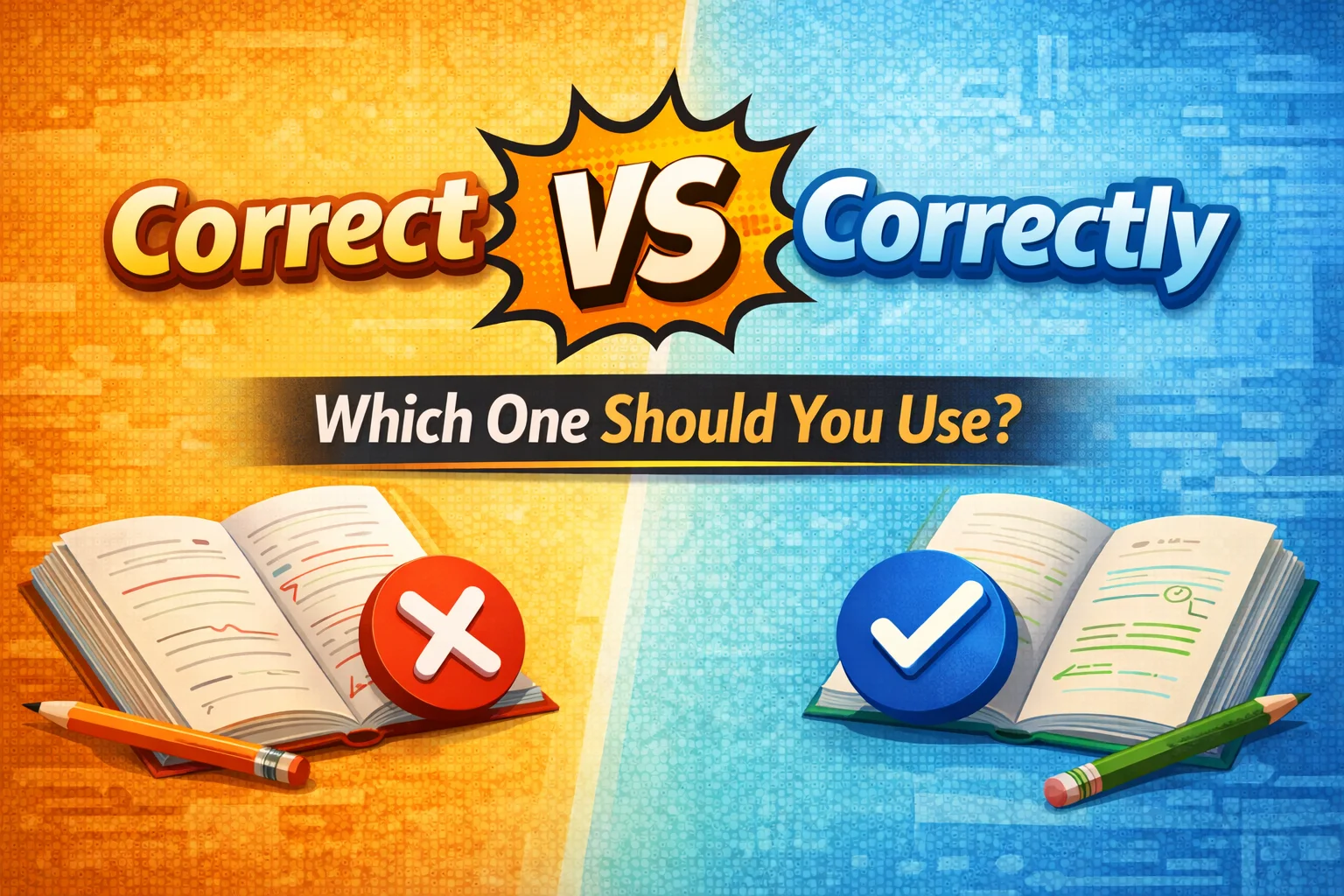
Many English learners often feel confused about Correct or Correctly. Both words look similar. Both come from the same root word. Yet they do different jobs in a sentence.
Using the right word helps your writing sound clear and natural. It also helps readers understand you better. A small grammar mistake can sometimes change the meaning of a sentence.
In simple terms, “correct” is an adjective, while “correctly” is an adverb. Adjectives describe nouns. Adverbs describe verbs, actions, or other adjectives.
This may sound technical at first. But do not worry. The idea is very simple once you see real examples.
In this guide, we will explore Correct or Correctly in a friendly and easy way. You will learn when to use each word, see examples, understand common mistakes, and get simple tricks to remember the difference.
By the end of this article, you will feel confident using Correct or Correctly in everyday English.
Understanding the Basic Difference Between Correct or Correctly
To understand Correct or Correctly, we must first understand two grammar roles: adjectives and adverbs.
The word correct is an adjective. It describes a noun or a pronoun. It tells us that something is right or accurate.
Example sentences:
- That answer is correct.
- Your spelling is correct.
- She gave the correct information.
In these examples, correct describes something. It describes an answer, spelling, or information.
Now let’s look at correctly.
The word correctly is an adverb. It describes an action. It explains how something is done.
Examples:
- He solved the problem correctly.
- She answered the question correctly.
- The student followed the instructions correctly.
Here, correctly explains how the action happened.
So the key idea in Correct or Correctly is simple:
- Correct = describes something
- Correctly = describes an action
Understanding this small difference makes your grammar much stronger.
Why People Confuse Correct or Correctly
Many learners mix up Correct or Correctly because the two words come from the same root. They look very similar. The only difference is the ending –ly.
In English, many adverbs end in –ly. For example:
- Quick → Quickly
- Slow → Slowly
- Careful → Carefully
- Correct → Correctly
Because of this pattern, learners sometimes forget when to add –ly.
Another reason for confusion is spoken English. In fast conversation, people sometimes shorten words or speak casually. This can make grammar rules less clear.
For example, someone might say:
“Did I do it correct?”
But the grammatically accurate sentence is:
“Did I do it correctly?”
Understanding the rule behind Correct or Correctly helps avoid these mistakes.
What Does “Correct” Mean?
The word correct means something is right, accurate, or free from mistakes.
It is used to describe nouns or ideas.
Examples:
- That answer is correct.
- You chose the correct option.
- His explanation was correct.
In each sentence, correct describes something specific.
The word can also appear before a noun.
Example:
- She gave the correct answer.
Here, correct describes the noun answer.
When deciding between Correct or Correctly, ask yourself one question:
“Am I describing something?”
If yes, then correct is the right choice.
What Does “Correctly” Mean?
The word correctly explains how something happens.
It is an adverb that modifies a verb or an action.
Examples:
- She spelled the word correctly.
- He completed the task correctly.
- The machine is working correctly.
In these sentences, correctly explains how the action happened.
This is the most important difference in Correct or Correctly.
If the word describes how someone did something, then correctly is needed.
Here is a simple comparison:
- The answer is correct.
- She answered the question correctly.
Both sentences are right. But they use different grammar roles.
Simple Examples of Correct or Correctly
Sometimes examples make grammar easier to understand. Let’s compare sentences using Correct or Correctly.
| Sentence | Explanation |
|---|---|
| The answer is correct. | Describes the answer |
| She answered correctly. | Describes how she answered |
| That is the correct method. | Describes the method |
| He followed the steps correctly. | Describes the action |
| Your grammar is correct. | Describes grammar |
| You used the grammar correctly. | Describes how it was used |
These examples show a clear pattern.
Use correct to describe a thing.
Use correctly to describe an action.
Once you see this pattern, choosing between Correct or Correctly becomes much easier.
Common Mistakes With Correct or Correctly
Many people make small grammar mistakes when choosing Correct or Correctly.
Here are some common errors.
Incorrect:
She answered the question correct.
Correct:
She answered the question correctly.
Why? Because the word describes how she answered.
Another mistake:
Incorrect:
Your answer is correctly.
Correct:
Your answer is correct.
In this case, the word describes the answer, not an action.
Here is another example.
Incorrect:
He did the work correct.
Correct:
He did the work correctly.
Learning these patterns helps avoid confusion with Correct or Correctly.
Easy Trick to Remember Correct or Correctly
If grammar rules feel confusing, try this simple trick.
Ask yourself this question:
“Am I describing something, or describing how something happens?”
If you describe something, use correct.
Example:
- That answer is correct.
If you describe how something happens, use correctly.
Example:
- She answered correctly.
Another trick is to look for verbs.
If the word follows an action like run, speak, write, answer, or solve, you usually need correctly.
Example:
- He solved the problem correctly.
These small tricks help learners choose between Correct or Correctly without thinking too hard.
Real-Life Examples of Correct or Correctly
Understanding Correct or Correctly becomes easier when we see everyday situations.
Imagine a teacher grading exams.
The teacher might say:
“The answer is correct.”
But the teacher could also say:
“You answered the question correctly.”
Both sentences are true. But they focus on different things.
Another example is learning to drive.
A driving instructor might say:
“You are holding the steering wheel correctly.”
Here, correctly describes how the student performs the action.
In daily life, we often switch between Correct or Correctly depending on what we want to describe.
Grammar Rules Behind Correct or Correctly
The difference between Correct or Correctly comes from basic grammar structure.
In English grammar:
Adjectives describe nouns.
Adverbs describe verbs.
The word correct is an adjective.
Example:
- That statement is correct.
The word correctly is an adverb.
Example:
- She stated the answer correctly.
Understanding this rule improves more than just Correct or Correctly.
It also helps with many other adjective and adverb pairs.
Examples include:
- Happy → Happily
- Quick → Quickly
- Easy → Easily
Learning these patterns helps you write more clearly and confidently.
When Both Correct and Correctly Can Appear
Sometimes sentences may contain both Correct or Correctly.
Example:
“The answer is correct because she solved the problem correctly.”
In this sentence:
- Correct describes the answer.
- Correctly describes the action of solving.
This shows how both words can work together.
Writers often use both forms to create clear explanations.
Understanding the difference helps make writing stronger and more professional.
Tips to Use Correct or Correctly in Writing
Using Correct or Correctly well can improve your writing skills.
Here are some helpful tips.
1. Identify the action
Look for verbs in the sentence.
If the word describes the verb, choose correctly.
2. Identify the noun
If the word describes a noun or idea, choose correct.
3. Read the sentence aloud
Sometimes hearing the sentence makes the mistake obvious.
4. Check your sentence structure
Good grammar often becomes clear when sentences are simple.
These small habits make it easier to use Correct or Correctly naturally.
Why Using Correct or Correctly Matters
Some people think grammar rules are not important. But small details like Correct or Correctly make communication clearer.
Using the right word helps readers trust your writing. It also shows strong language skills.
In school, correct grammar improves grades. In professional writing, it improves credibility.
Even in casual communication, clear language avoids misunderstandings.
Learning the difference between Correct or Correctly is a small step. But it makes a big difference in writing quality.
Frequently Asked Questions
1. What is the difference between correct and correctly?
The difference between Correct or Correctly is grammar role. Correct is an adjective. It describes nouns or ideas. Correctly is an adverb. It describes actions or verbs.
2. Is it “did I do it correct” or “did I do it correctly”?
The correct sentence is “Did I do it correctly?” because the word describes how the action was done.
3. Can correct be used as an adverb?
In standard grammar, correct is mainly used as an adjective. Some informal speech may use it as an adverb, but correctly is the proper form.
4. When should I use correctly in a sentence?
Use correctly when describing an action. For example:
“She solved the puzzle correctly.”
5. Is “the answer is correctly” correct?
No, this sentence is incorrect. The proper sentence is “The answer is correct.” because the word describes the noun answer.
6. Why do adverbs often end in –ly?
Many English adverbs end with –ly because they are formed from adjectives. For example: correct → correctly, quick → quickly.
Conclusion
Understanding Correct or Correctly is easier than it first appears. The key difference comes from grammar roles.
The word correct is an adjective. It describes nouns or ideas. The word correctly is an adverb. It explains how an action happens.
A simple rule helps remember this difference. If the word describes something, use correct. If it describes how something is done, use correctly.
Small grammar choices can greatly improve communication. Using Correct or Correctly the right way makes writing clearer and more professional.
The best way to master this rule is practice. Try writing your own sentences. Pay attention to verbs and nouns.
Over time, choosing between Correct or Correctly will feel natural. And your English will become stronger and more confident.