Many English learners feel confused about “Ourselves or Ourself.” The words look similar, but they do not work the same way. Choosing the correct one helps your writing sound clear and natural. Even native speakers sometimes pause when deciding which form to use.
In simple terms, “ourselves” is the standard and correct reflexive pronoun for “we.” It refers to more than one person. On the other hand, “ourself” is rare and usually appears only when a group is treated as a single unit, such as in formal or historical writing.
Understanding Ourselves or Ourself is important for students, writers, bloggers, and anyone learning English grammar. The good news is that the rule is simple once you see how pronouns work.
In this guide, you will learn the difference between Ourselves or Ourself, when to use each one, common mistakes, and helpful examples. By the end, you will feel confident using the correct word in everyday conversations and writing.
Understanding Reflexive Pronouns in English
Before comparing Ourselves or Ourself, it helps to understand reflexive pronouns. These pronouns refer back to the subject of the sentence.
Common reflexive pronouns include:
| Subject | Reflexive Pronoun |
|---|---|
| I | Myself |
| You | Yourself |
| He | Himself |
| She | Herself |
| It | Itself |
| We | Ourselves |
| They | Themselves |
Reflexive pronouns usually end in “-self” or “-selves.” They are used when the subject and object are the same.
Example sentences:
- We prepared the meal ourselves.
- She fixed the bike herself.
- They introduced themselves at the meeting.
Notice that “ourselves” matches the plural subject “we.” This is why it is usually the correct choice.
The confusion between Ourselves or Ourself happens because some people assume every pronoun has a singular and plural form. In reality, English grammar mainly uses “ourselves” for the pronoun “we.”
Understanding reflexive pronouns makes it easier to choose the correct form.
What Does “Ourselves” Mean?
The word “ourselves” is a plural reflexive pronoun. It refers to a group that includes the speaker.
It is used when “we” perform an action on ourselves or when we emphasize that a group did something without help.
Examples:
- We taught ourselves how to cook.
- We should believe in ourselves.
- We introduced ourselves to the new team.
In each sentence, the action returns to the subject “we.”
Another common use is for emphasis.
Example:
- We built the website ourselves.
Here, the speaker wants to stress that they did the work personally.
When people ask about Ourselves or Ourself, remember this key point: “ourselves” is the normal and correct form in modern English.
Because “we” is plural, the reflexive pronoun also becomes plural.
This rule is simple and reliable in almost every situation.
What Does “Ourself” Mean?
The word “ourself” exists in English, but it is rare and uncommon today.
It appears mainly when “we” represents a single group acting as one unit. For example, a company, government, or organization may speak collectively as one body.
Example:
- As a company, we must improve ourself.
Even in that case, many modern writers still prefer “ourselves.”
Historically, “ourself” was used by kings and queens when they spoke as the state or nation. This style is called the royal we.
Example from historical language:
- We declare ourself the ruler of this land.
However, this style sounds very formal or old-fashioned today.
That is why most grammar guides recommend using “ourselves” instead of “ourself.”
When people compare Ourselves or Ourself, the second option is rarely needed in everyday English.
Ourselves vs Ourself: The Key Difference
Understanding the difference between Ourselves or Ourself becomes easier when you look at number and usage.
Here is a simple comparison.
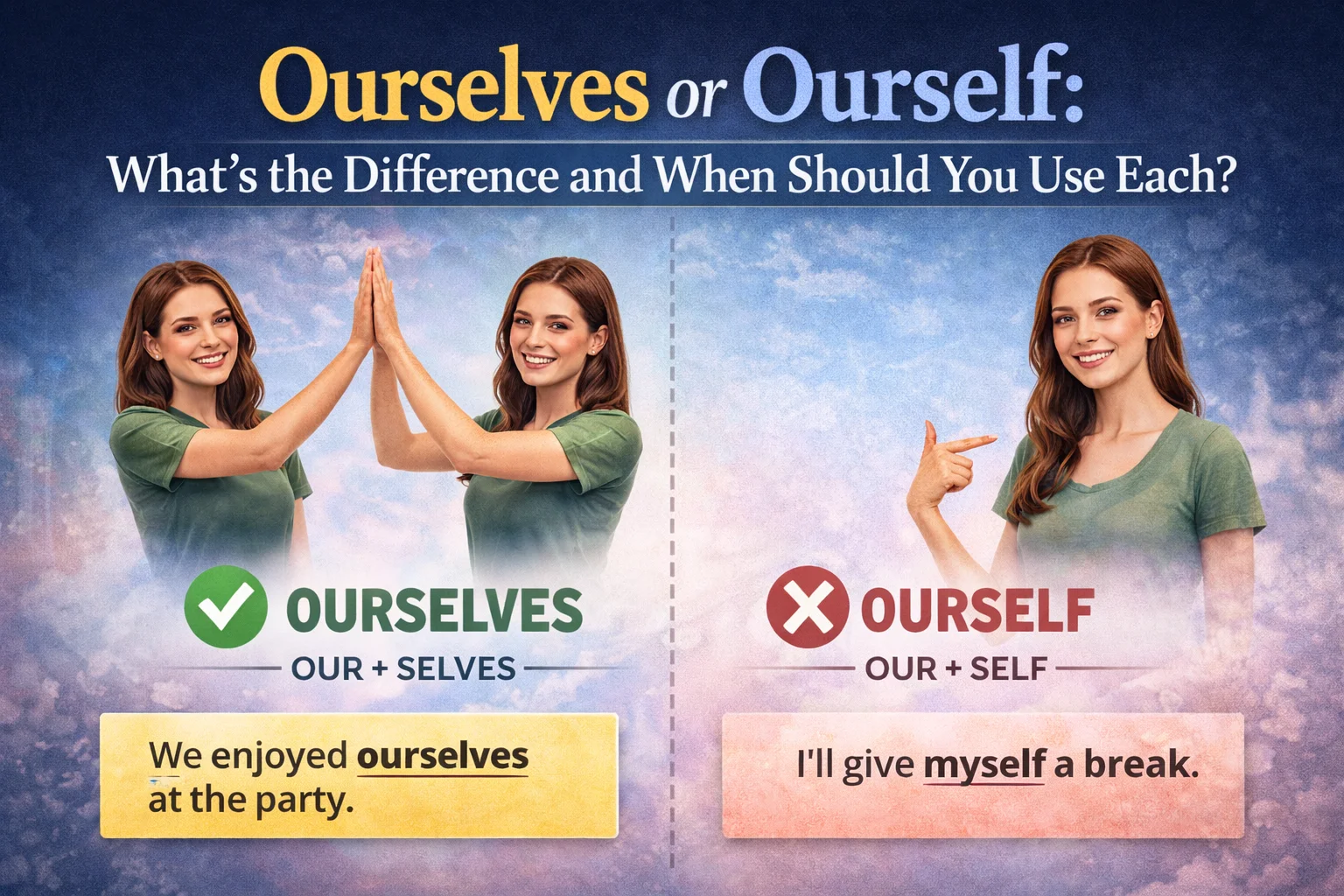
| Word | Type | Usage | Example |
|---|---|---|---|
| Ourselves | Plural reflexive pronoun | Used with “we” in normal situations | We enjoyed ourselves. |
| Ourself | Rare singular collective reflexive | Used when “we” acts as a single unit | We must ask ourself this question. |
The main rule is simple:
Use “ourselves” in almost every situation.
The form “ourself” appears mainly in:
- Historical writing
- Formal institutional language
- The royal “we”
For everyday speaking and writing, choosing “ourselves” will almost always be correct.
Why “Ourselves” Is the Standard Form
English grammar prefers plural agreement between the subject and the reflexive pronoun.
Since “we” is plural, the matching reflexive pronoun becomes “ourselves.”
Example:
- We congratulated ourselves on finishing the project.
Using “ourself” here would sound incorrect to most readers.
Language evolves over time. Many forms used centuries ago are no longer common. That is exactly what happened with “ourself.”
Today, writers choose “ourselves” because it follows clear grammar rules and sounds natural.
If you remember one tip about Ourselves or Ourself, remember this:
Modern English almost always prefers “ourselves.”
Common Situations Where “Ourselves” Is Used
You will see “ourselves” used in several everyday situations.
1. Reflexive actions
When a group performs an action on itself.
Example:
- We reminded ourselves about the meeting.
2. Emphasis
When the speaker wants to stress independence.
Example:
- We built the house ourselves.
3. Self-reflection
When people talk about personal growth or thinking.
Example:
- We should ask ourselves important questions.
These examples show why “ourselves” appears often in daily English.
Because of its flexibility, it easily fits in many sentences.
When comparing Ourselves or Ourself, the first option clearly dominates real-life usage.
When “Ourself” Might Be Used
Although rare, “ourself” sometimes appears in specific contexts.
1. Formal institutional voice
Organizations may speak as one unit.
Example:
- As a nation, we must protect ourself.
2. Historical writing
Older texts often used singular collective pronouns.
3. Royal or ceremonial language
Kings or leaders sometimes used the royal “we.”
Example:
- We declare ourself responsible for this decision.
Even in these cases, modern writers often switch to “ourselves.”
That is why the debate around Ourselves or Ourself usually ends with the same advice: use “ourselves” unless you have a special reason not to.
Common Mistakes People Make
Many learners struggle with Ourselves or Ourself because reflexive pronouns can feel tricky.
Here are common mistakes.
1. Using “ourself” in normal sentences
Incorrect:
- We enjoyed ourself at the party.
Correct:
- We enjoyed ourselves at the party.
2. Forgetting reflexive pronouns
Incorrect:
- We taught how to cook.
Correct:
- We taught ourselves how to cook.
3. Overusing reflexive forms
Incorrect:
- John and myself went to the store.
Correct:
- John and I went to the store.
Understanding these errors helps you use Ourselves or Ourself correctly and confidently.
Real-Life Examples in Sentences
Let’s look at practical examples that show the difference clearly.
Using ourselves:
- We challenged ourselves to learn a new skill.
- We introduced ourselves at the meeting.
- We prepared ourselves for the exam.
Using ourself (rare):
- As a society, we must improve ourself.
In everyday conversation, you will almost always hear “ourselves.”
If you listen to native speakers, you will notice that “ourself” rarely appears.
This real-world observation makes the choice between Ourselves or Ourself much easier.
Tips to Remember the Correct Form
Learning grammar becomes easier with simple tricks.
Here are some helpful tips.
Tip 1: Match the number
“We” is plural, so use “ourselves.”
Tip 2: Use the “selves” rule
Plural pronouns usually end with “-selves.”
Examples:
- themselves
- ourselves
- yourselves
Tip 3: Avoid “ourself” in everyday writing
Unless you are writing historical or formal text, stick with “ourselves.”
These small tricks will help you master the difference between Ourselves or Ourself quickly.
Why Correct Pronoun Usage Matters
Using correct grammar improves communication. It also builds credibility in writing.
When readers see correct pronoun usage, they trust the writer more. This is especially important for bloggers, students, and professionals.
Understanding Ourselves or Ourself helps you:
- write clearer sentences
- avoid grammar mistakes
- sound more natural in English
- improve professional communication
Even small grammar choices can shape how readers see your writing.
That is why learning the difference between Ourselves or Ourself is worth the effort.
Frequently Asked Questions
1. Is “ourself” grammatically correct?
Yes, “ourself” is technically correct, but it is rare in modern English. Most writers use “ourselves.”
2. Which is correct: ourselves or ourself?
In everyday English, “ourselves” is correct in almost all situations.
3. Why do people use “ourself” sometimes?
It appears in formal, historical, or collective contexts, such as government or royal speech.
4. Can “ourself” replace “ourselves”?
Usually no. Replacing “ourselves” with “ourself” will sound incorrect in most sentences.
5. Is “ourselves” singular or plural?
“Ourselves” is plural because it refers to more than one person.
6. Is “ourself” used in modern writing?
Very rarely. Most modern writers prefer “ourselves.”
Conclusion
The difference between Ourselves or Ourself becomes simple once you understand how reflexive pronouns work.
“Ourselves” is the correct and common form used with the plural subject “we.” It appears in everyday speech, writing, and professional communication.
Meanwhile, “ourself” is rare and mostly limited to formal or historical contexts. Many modern writers avoid it entirely.
If you want your English to sound natural, remember this easy rule:
When in doubt, choose “ourselves.”
Mastering small grammar details like Ourselves or Ourself helps improve clarity, confidence, and writing quality.
The more you practice, the easier it becomes to use the correct form without thinking.
And when you communicate clearly, your message becomes stronger and easier for others to understand.